
What to Do When Your Dog Barks or Acts Aggressively Toward Guests
Published: 09/30/2026
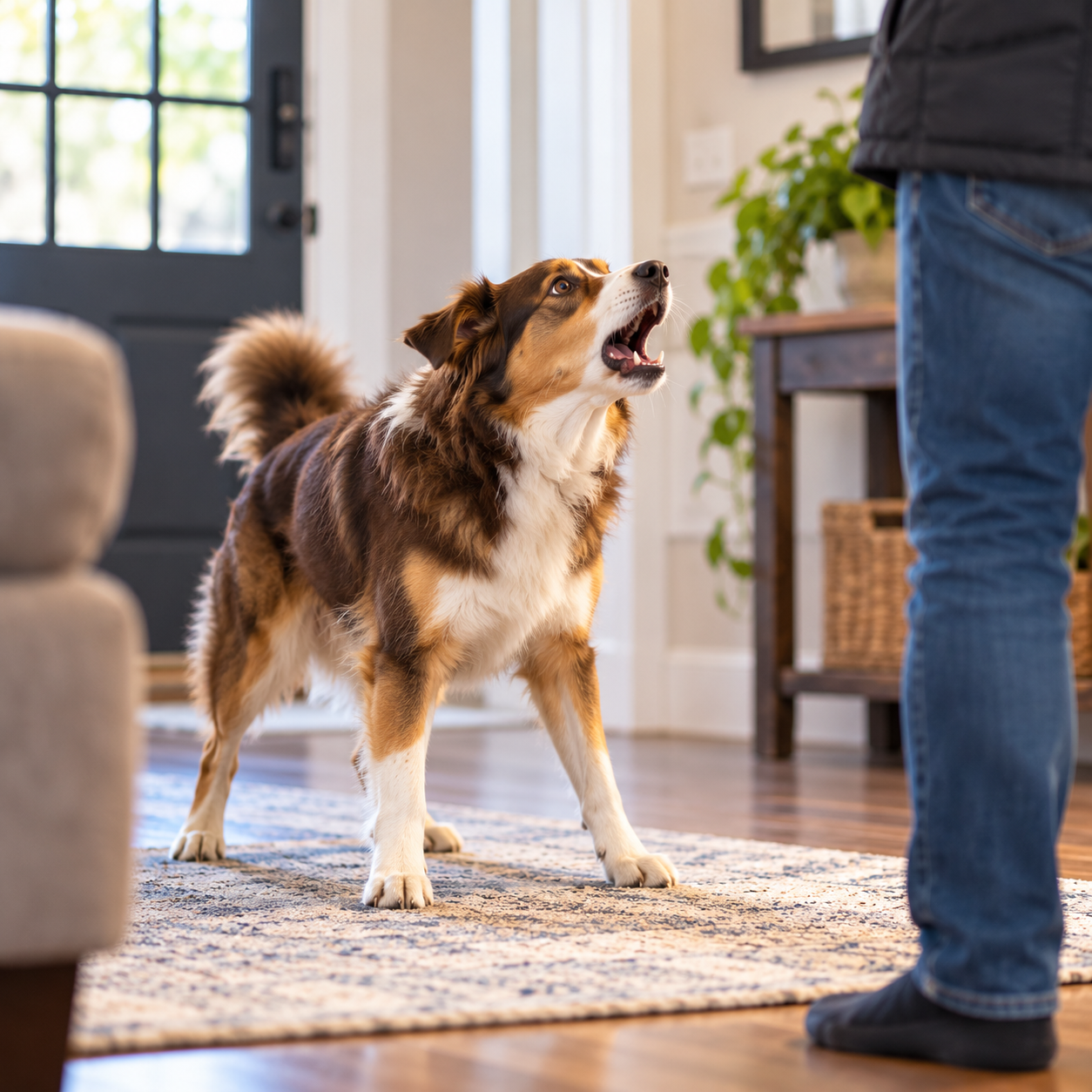
If your dog barks, growls, or acts aggressively when guests come into your home, having people over can quickly become stressful for you, your guests, and especially your dog.
One of the first things to understand is that these situations often involve more than just territorial behavior. Many of the dogs I work with in these cases also have fearful tendencies. That can put the dog in a difficult situation because they want the unfamiliar person to stay away from them, but at the same time, that person is entering their territory.
Understanding what is happening from the dog’s perspective can help you put together a much better training plan.
Why Your Dog May Bark or Growl at Guests
When a fearful or uncomfortable dog encounters a stranger inside the home, you may see barking, growling, pacing back and forth, and other restless behaviors. In many cases, the purpose of these behaviors is fairly simple. The dog is trying to create distance.
The dog is essentially communicating, “I’m uncomfortable with you. Please stay away from me.” But there is a problem. The person is not walking away. They are entering the dog’s home.
Now you have two things happening at the same time. The dog’s territorial behavior is telling them to respond to someone entering their space, while their fear is telling them they want more distance from that person. Because they are inside a house, there may also be limited room for the dog to move away.
That combination can create quite a bit of anxiety and conflict for the dog.
Don’t Try to Befriend a Dog While They’re Telling You to Stay Away
This is one of the most common mistakes I see. A dog starts barking or growling, and the guest understandably wants to show the dog that they are friendly.
They may crouch down, extend the back of their hand for the dog to smell, talk sweetly to the dog, or even move closer while trying to pet them. From a human perspective, the person is saying, “Look, I’m friendly. You don’t need to worry about me.”
But that is not necessarily what the dog experiences. The dog has just communicated, “I want you to stay away from me,” and instead of creating distance, the person moves closer.
From the dog’s perspective, it is almost like saying, “I’m telling you to stay away. Why aren’t you listening?”
That can increase the dog’s anxiety and potentially cause the behavior to escalate. Instead of making it the guest’s responsibility to convince your dog that they are friendly, you, as the dog’s owner, need to take control of the situation.
Give your dog something specific to do, and make sure that doing what you have asked leads to a place of safety.
Start by Removing the Dog Before Your Guest Enters
During the initial stages of training, I often recommend taking the dog out of the situation before the guest even walks through the door. Put your dog in another room, in their crate, in the backyard, or somewhere else where they cannot watch the person enter the home.
The doorway itself can be one of the most difficult parts of the entire interaction. Your dog sees a stranger physically crossing the threshold and entering their territory. If your dog is already fearful of unfamiliar people, you are combining that fear with a strong territorial trigger.
Instead, let your guest come inside without the dog present. Have your guest sit down and get comfortable, and give the situation a little time to settle. Then, if it is appropriate for your particular dog, you can bring the dog out.
Now the dog is encountering someone who is already inside the home instead of watching that person enter their territory. For many dogs, that is a much easier situation to handle.
That does not mean your dog can never learn to calmly watch someone enter the house. That may eventually become part of your training. But during the initial stages, there is no reason to start with the most difficult part of the problem.
Give Your Dog a Specific Job
Once you bring your dog into the room, do not simply release them and hope everything goes well. Give them something specific to focus on.
For example, I frequently use a designated dog bed or “place.” The dog learns to go to the bed, remain there, and focus on that behavior. You can reward the dog for staying calm and doing what you have asked.
This accomplishes several things. Instead of pacing around the room and monitoring the guest, the dog has a clear job. It also gives the owner something specific to reinforce instead of constantly reacting to barking and growling.
There is also another important part of this exercise.
Your Dog’s Place Needs to Be a Safe Place
If I have told a fearful dog to stay on a particular dog bed, I do not allow the guest to walk over and pet the dog while they are on that bed. The dog needs to learn, “If I do what my owner asks me to do, I’m safe here.”
The same concept can apply to a crate or another designated area. This is particularly important because our goal is not simply to stop the barking. We also want the dog to become more comfortable with the situation.
You are giving the dog clear direction while also showing them that they do not have to personally manage the stranger. That is an important distinction.
Your Guest Give Your Dog Treats?
Food can certainly be incorporated into this type of training, and I frequently use it. However, I am usually cautious about having the guest actively feed the dog from their hand, particularly early in the process.
The problem usually is not the food. It is what people tend to do while giving the food.
Someone offers the dog a treat. The dog gets brave enough to approach and take it. The person gets excited because they think they have made friends. Then they start talking to the dog, reaching toward the dog, or immediately trying to pet them.
The dog may have approached because of the food without actually being comfortable with the person being that close. Now we have added social pressure at exactly the wrong moment.
If I want the guest involved with food, I may instead have them simply drop or toss treats while otherwise ignoring the dog. The dog can begin associating the person’s presence with something positive without being required to interact with them directly.
“Just Ignore the Dog” Isn’t Always as Easy as It Sounds
Sometimes I will have a guest simply ignore the dog completely. No eye contact, no reaching, no talking to the dog, and no attempting to pet them.
This can work very well with certain dogs. The problem I have found over many years of working with these cases is that people are not always very good at ignoring dogs.
They naturally want to help. They want to talk to the dog, they want the dog to like them, and when the dog finally approaches, it is very tempting to reach down and pet them.
That is one reason I generally prefer giving the owner a clear plan and giving the dog a specific behavior to perform rather than making the entire training plan dependent on the guest following directions perfectly.
Remember What Your Dog Is Trying to Accomplish
When you are dealing with barking and growling toward guests, it is easy to focus entirely on stopping those behaviors. But remember what may be happening underneath them.
If your dog is afraid, the barking and growling may be an attempt to make the uncomfortable person move farther away. When the person responds by moving closer, your dog may feel like their communication is not working. That can increase anxiety and potentially cause them to try something more intense.
Instead, we want to teach the dog that they do not have to handle the situation themselves. The owner takes control.
You tell your dog what you want them to do, reinforce that behavior, and, just as importantly, make sure doing what you have asked leads to safety. Over time, you can gradually work toward more difficult situations as the dog’s behavior and emotional response improve.
Every Dog Is Different
These are some basic steps you can use to begin improving the situation, but there is not one training protocol that is appropriate for every dog that barks or acts aggressively toward visitors.
A dog that barks but quickly settles down is very different from a dog with significant fear or a history of biting guests. The dog’s body language, triggers, distance from the guest, ability to recover, and previous behavior all matter.
If your dog is showing significant aggression toward people entering your home, particularly if there has already been a bite, I recommend working with a professional trainer who has substantial experience with fear, territorial behavior, and aggression.
The ultimate goal is not simply to have a dog that stops barking. It is to have a dog that understands what you want them to do, trusts you to manage the situation, and can become increasingly comfortable when people enter your home.
If you're in the Arlington, Marysville, Stanwood, or Everett area and struggling with your dog’s barking, fear, or aggressive behavior around guests? Book a private dog training lesson here, and we can put together a training plan for your dog.