
3 Tips to Help Leash Reactive Dogs
Published: 09/22/2026
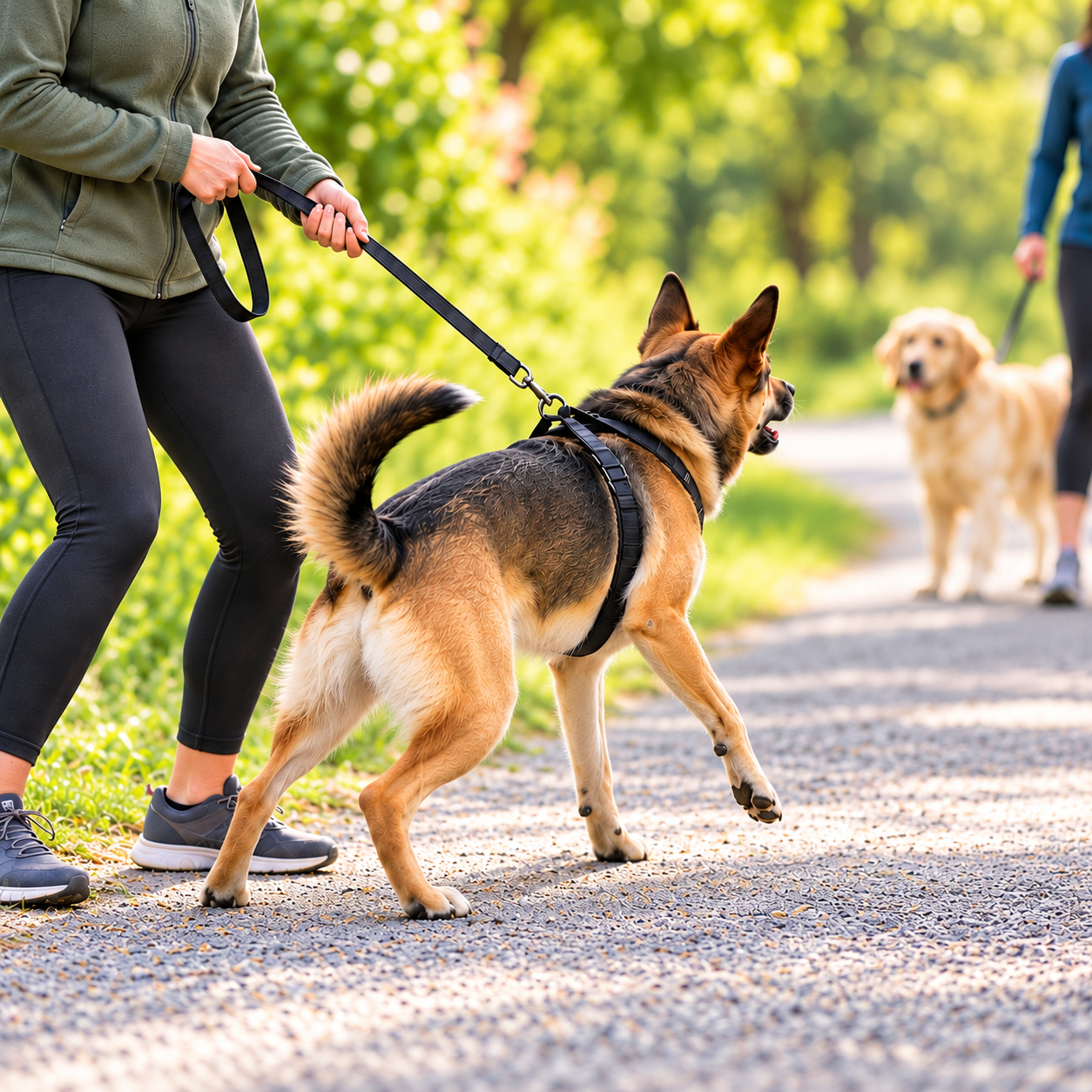
Last week I was working with an English Bulldog in Marysville. He was a terrific dog, but he had a very common problem. Every time he saw another dog, he went into a high state of arousal and started barking and lunging on the leash.
His owner is far from alone. Leash reactivity can be frustrating and, at times, difficult to work through. For many dog owners, something as simple as taking a walk through the neighborhood becomes stressful because their dog is barking, lunging, pulling, or becoming overly excited whenever another dog appears.
The good news is that leash reactivity can improve significantly with the right approach and consistent practice.
While every dog is different and some cases are more complex than others, there are a few basic principles that can make the process much easier. Here are three tips I recommend when you begin working through leash reactivity with your dog. If you're not sure why your dog is reacting in the first place, start with my article on the 7 most common causes of leash reactivity.
1. Choose Your Training Location Carefully
Where you practice matters.
One of the biggest mistakes I see people make is trying to solve their dog's leash reactivity in the exact environment where the problem is most difficult, usually their own neighborhood.
This makes sense. After all, that's where you ultimately want to be able to walk your dog. But it isn't always the best place to begin.
Your dog may already have a long history of reacting to dogs in your neighborhood. They may know exactly which houses have dogs behind the fence or which dogs tend to bark back at them. You may even notice your dog becoming alert before you reach a particular house because they already know what's coming.
These repeated experiences create patterns.
Your dog may begin scanning for other dogs as soon as you leave the house. By the time you encounter one, your dog may already be highly aroused and prepared to react.
There's another problem with neighborhood walks: many of the dogs you encounter are on their own property.
Dogs can naturally be more territorial around their homes and yards. If you walk past a fenced yard and another dog begins barking aggressively at your dog, you're asking your dog to remain calm while another dog is sending some very strong signals toward them.
That's much harder than simply learning to walk past a neutral dog.
Instead, when I'm beginning to work with a leash reactive dog, I often recommend getting the dog away from their immediate neighborhood.
Find two or three locations where your dog doesn't have the same history or emotional associations. Parks, wider walking paths, or other open areas can work well.
Most importantly, choose locations where you can control distance.
On a neighborhood sidewalk, you may only have a few feet between you and another dog. You can't simply walk through someone's front yard to create more space.
In an open area, you can increase your distance easily if necessary. That gives you much more control over the situation and allows you to find a distance where your dog can notice another dog without immediately becoming overwhelmed.
Build success in these easier environments first. As your dog improves, you can gradually begin working in more challenging locations, with the eventual goal of returning to normal neighborhood walks.
2. Build a Foundation of Obedience and Leash Walking
Before focusing entirely on your dog's reaction to other dogs, make sure you have a basic training foundation in place.
Your dog doesn't need advanced obedience. They don't need to walk perfectly at your side every second of the walk.
What you do need is a reliable system of communication between you and your dog.
For example, if your dog can't remain on a dog bed for a few minutes inside your quiet home, it's probably unrealistic to expect them to remain calm and focused when another dog suddenly appears outside.
We need to build the easier skills before expecting the harder ones.
The same principle applies to leash walking.
If your dog is pulling you down the street and there is constant tension on the leash even when no other dogs are around, adding another dog to the situation is only going to make things more difficult.
Spend time improving your dog's general leash skills first.
Teach your dog how to move with you. Teach them how to respond to leash pressure. Practice changing directions, stopping, slowing down, and paying attention to you.
The better your communication is when nothing exciting is happening, the easier it becomes to communicate when another dog appears.
3. You Have to Practice
This may be the most important part of the process, and sometimes the most difficult.
You have to practice.
I understand that people have jobs, families, and other commitments. It's easy to take your dog for a quick walk around the block when you have time and hope the problem gradually gets better.
But if you want to make meaningful progress with leash reactivity, you need repetitions.
People often ask me, "How long is it going to take to fix this?"
One of the biggest factors is how often you're actually practicing.
Someone who goes out four or five times a week and gets several controlled opportunities to work around other dogs can potentially make more progress in two weeks than someone whose dog only sees one or two dogs during an entire week.
Think about what you're actually practicing.
Many owners of reactive dogs understandably become very good at avoiding other dogs. They see a dog coming and immediately turn around, cross the street, or go home.
Avoidance can certainly be useful when you need to prevent a bad situation, but avoiding every dog doesn't give you many opportunities to teach your dog a different response.
At some point, your mindset needs to change from:
"I hope we don't see another dog."
to:
"I need controlled opportunities to practice around other dogs."
That doesn't mean walking directly toward every dog you see. It means intentionally finding situations where you can work at an appropriate distance and gradually build your dog's ability to remain calm and responsive.
For someone who has been struggling with a severely reactive dog, intentionally looking for other dogs can sound intimidating. That's also one of the reasons I often work with clients in public and walk them through this process in real-world situations.
Focus on Progress, Not Perfection
Leash reactivity can be complex, and these three tips are only part of the overall process. Depending on the dog, we may need to address fear, frustration, territorial behavior, leash handling, obedience, engagement, distance, and several other factors.
But leash reactivity can often improve tremendously.
I also encourage owners to think about improvement in percentages rather than expecting the behavior to disappear overnight.
If your dog currently reacts to 90 to 100% of the dogs you encounter, our first goal might be to reduce that significantly. Then we continue working until those reactions become less frequent, less intense, and easier to interrupt.
Eventually, the dog that once reacted to nearly every dog may be able to pass most dogs without a major reaction.
That's real progress.
Start by choosing the right environment. Build a solid foundation of training and leash skills. Then get out there and practice consistently.
If you're in the Arlington, Marysville, Stanwood, or Everett area and struggling with leash reactivity, we can help. Most dogs start with private lessons, where we work with you and your dog in real-world environments and gradually build toward more challenging situations. For some dogs, our board and train program is a great way to build a strong foundation first.
You might also like 7 Common Reasons of Leash Reactivity